In the modern academic landscape, the sheer volume of reading, research, and writing can be overwhelming. Higher education in the United States has transitioned into a high-speed digital environment where “working harder” is no longer enough; students must work smarter. Whether you are navigating a rigorous STEM program or a dense liberal arts curriculum, the difference between burnout and Dean’s List often comes down to the tools you use to manage your time and cognitive load.
According to recent educational technology surveys, nearly 70% of college students believe that digital learning tools have helped them improve their grades. However, with thousands of apps available in the App Store and Google Play, finding the ones that actually move the needle on productivity is a challenge in itself. To help you regain control of your schedule, we have curated the ultimate guide to resources that streamline daily coursework.
The Foundation of Academic Productivity
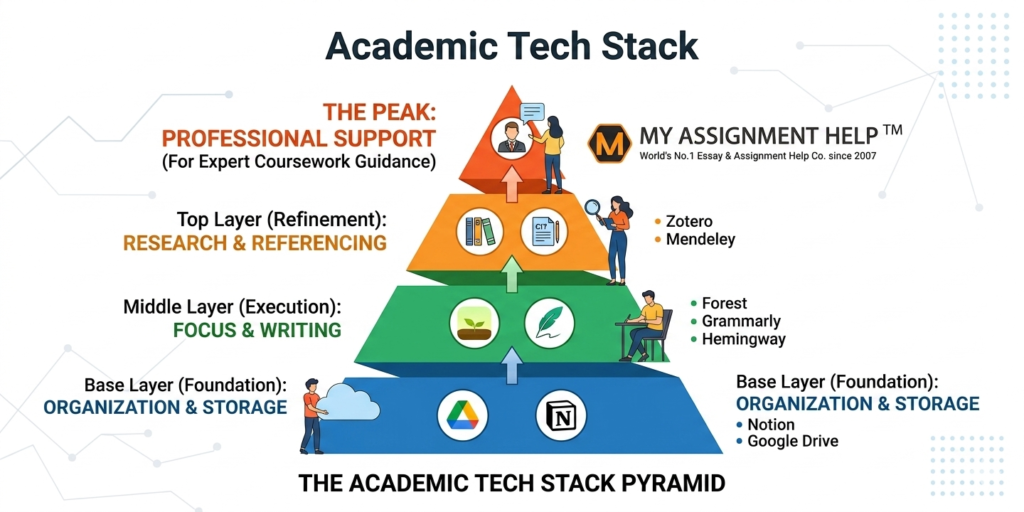
Before diving into niche tools, it is essential to establish a reliable foundation. A student’s workflow is only as strong as their organization. If you find yourself staring at a blank screen as a deadline looms, you might feel the urge to find a professional to write my coursework to get back on track. While professional guidance is a valid way to understand complex rubrics, integrating the following apps into your daily routine can prevent that last-minute panic from occurring in the first place.
1. Research and Reference Management
The backbone of any high-quality assignment is credible research. Manually tracking citations in APA, MLA, or Chicago style is a notorious time-sink.
- Zotero: This is an open-source, free tool that acts as your personal research assistant. It senses content in your web browser, allowing you to add papers from JSTOR or Google Scholar with a single click. It automatically generates bibliographies, saving hours of manual formatting.
- Mendeley: Excellent for students in sciences, Mendeley combines a reference manager with a social network for researchers. It allows for easy PDF annotation and cloud synchronization across devices.
- Purdue OWL: While not an “app,” the Purdue Online Writing Lab remains the gold standard for U.S. academic standards. It provides updated guidance on E-E-A-T (Experience, Expertise, Authoritativeness, and Trustworthiness) principles in writing.
2. Concentration and Focus Tools
The “Attention Economy” is the enemy of the student. Research from the University of California, Irvine, suggests it takes an average of 23 minutes to return to a task after a distraction.
- Forest: This app gamifies focus. When you want to study, you plant a virtual tree. If you leave the app to check social media, your tree withers and dies. Over time, you can earn credits to plant real trees through the organization “Trees for the Future.”
- Freedom: This is a powerful website blocker that syncs across your Mac, Windows, and iOS/Android devices. You can schedule “Blackouts” where distracting sites are completely inaccessible during your peak study hours.
Strategic Support for Complex Assignments
Sometimes, even with the best apps, the technical demands of a specific curriculum—like Nursing, Law, or Advanced Data Analytics—require a human touch. For students managing international standards or heavy credit loads, seeking assistance from a reputable platform like myassignmenthelp can provide the necessary bridge to academic success. When seeking cheap assignment help, it is vital to ensure that the service prioritizes original research and adheres to US university integrity standards.
3. Writing and Grammar Enhancement
AI-driven writing assistants have evolved beyond simple spell-checkers. They now analyze tone, clarity, and structural logic.
- Grammarly: Beyond fixing typos, the premium version of Grammarly offers a plagiarism checker and “Goal Setting” features that allow you to tailor your writing to an “Academic” or “Formal” audience.
- Hemingway Editor: This tool is designed to improve readability. It highlights “yellow” and “red” sentences that are too dense or complex, forcing you to simplify your prose—a critical skill for clear communication in coursework.
Data-Driven Insights: The Skill-to-Salary Bridge
Understanding why you are doing the coursework is a powerful motivator. In the US market, the correlation between mastering digital tools and future earnings is significant.
| Tool Category | Core Skill Developed | Entry-Level Salary Impact (Estimated) |
| Data Visualization (Tableau/Excel) | Analytical Reasoning | +15% |
| Project Management (Asana/Trello) | Operational Efficiency | +10% |
| Advanced Writing (Scrivener/LaTeX) | Technical Communication | +12% |
Source: National Association of Colleges and Employers (NACE) 2025 Career Readiness Report.
Collaborative Resources for Group Projects
Group work is a staple of American higher education, yet it is often the most stressful part of a semester.
- Notion: This is the “all-in-one” workspace. You can build a shared database for group notes, embed Google Drive files, and track project milestones. Its versatility makes it the preferred tool for students who want to build a “Second Brain.”
- Slack: Moving group chats away from iMessage or WhatsApp into Slack helps maintain a professional boundary and ensures that important files don’t get lost in a sea of memes.
Key Takeaways for Academic Success
- Automate the Mundane: Use Zotero or Mendeley to handle citations so you can focus on the actual content of your arguments.
- Protect Your Focus: Use tools like Forest to build a “deep work” habit.
- Verify Your Sources: Always cross-reference AI-generated summaries with primary sources to maintain academic integrity.
- Seek Quality Support: When time is short, leverage authoritative platforms that offer expert-led guidance and regional expertise.
See also: How Technology Is Rewriting the Rules of Productivity
FAQ Section
Q: Are these apps considered “cheating” by US universities?
A: No. Reference managers, focus timers, and grammar checkers are considered “Productivity Tools.” However, always check your specific syllabus regarding the use of Generative AI for writing.
Q: How do I know if an assignment help service is trustworthy?
A: Look for E-E-A-T signals: Do they provide samples? Are their writers qualified? Do they have a clear plagiarism policy? Services that offer transparent communication are generally the most reliable.
Q: Is Notion free for students?
A: Yes, Notion offers a “Personal Pro” plan for free to students with a valid .edu email address, which allows for unlimited file uploads.
Q: What is the best way to handle a massive 1,500-word coursework deadline?
A: Break it into “Sprints.” Use the Pomodoro technique (25 minutes of work, 5 minutes of rest) and utilize a structured outline before you start writing.
Author Bio
Dr. Sarah Jenkins is a Senior Academic Consultant at MyAssignmentHelp. With over 12 years of experience in higher education and content strategy, Dr. Jenkins specializes in helping students navigate the complexities of the US and Canadian academic systems. She holds a PhD in Educational Technology and is a frequent contributor to journals regarding the intersection of AI and pedagogy. When she isn’t auditing curriculum standards, she mentors students on developing E-E-A-T compliant research methodologies.
References & Data Sources
- National Center for Education Statistics (NCES), “Digital Learning Trends in Postsecondary Education,” 2025.
- Purdue Online Writing Lab (OWL), “Academic Integrity and E-E-A-T Standards,” 2026.
- NACE (National Association of Colleges and Employers), “2025 Student Survey: Career Readiness and Digital Literacy.”
- Journal of Educational Psychology, “The Impact of Task-Switching and Distraction on Undergraduate GPA,” 2024.
